Consumer Rights Act 2015: Your Delivery Rights Explained
Not sure who owes you a refund? Free check, no signup.
Published
Updated
Quick Answer
Under the Consumer Rights Act 2015, the retailer is responsible for your goods until they are delivered into your possession. If a delivery is late, lost, damaged, or sent to the wrong place, the retailer usually has to put it right.
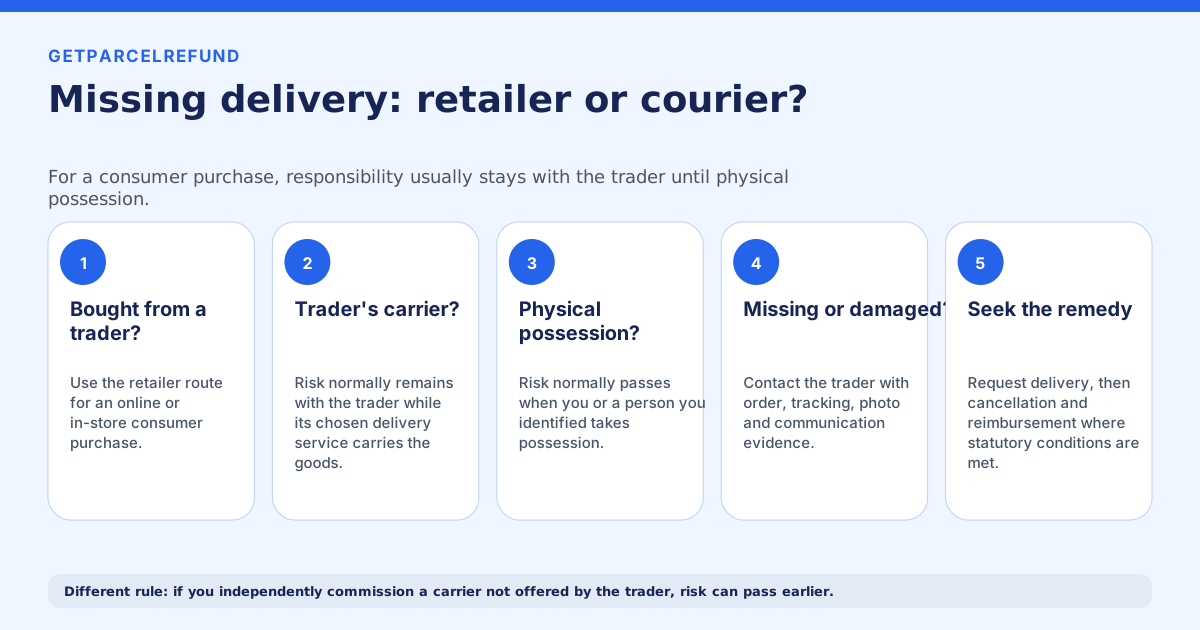
The decision tree starts with who arranged the carrier, follows the ordinary retailer-delivery route through physical possession and remedies, and identifies the independently commissioned carrier exception in section 29(3).
What the Consumer Rights Act 2015 Means for Deliveries
The Consumer Rights Act 2015 is the main UK law that protects you when you buy goods from a business. For delivery disputes, the key point is simple: the retailer stays responsible until the goods reach you. That is why the law matters so much when parcels are late, lost, damaged, or delivered to the wrong address.
Section 28: Delivery of Goods
Section 28 deals with delivery timing. If no delivery date was agreed, the default rule is that goods should arrive within 30 days. If the retailer misses the agreed date or takes an unreasonable amount of time, you may be able to cancel and ask for a refund. You can also give the retailer a short final deadline in writing before cancelling.
Section 29: Passing of Risk to You
Section 29 is the rule most people need for parcel disputes. It says the risk does not pass to you until the goods are delivered into your possession. So if a parcel is lost in transit, left somewhere unsafe, stolen before it reaches you, or damaged before delivery is complete, the retailer is usually still responsible. That is the rule that sits behind a typical parcel marked delivered but not received complaint. The same protection applies regardless of which courier is involved. For Royal Mail orders, the retailer-first Royal Mail refund route follows the same principle; see our Royal Mail compensation and Evri lost parcel claim pages for courier-specific complaint routes. There is a narrow exception: if you independently commission a carrier the trader did not offer, section 29(3) can move the risk to you when the trader hands the goods to that carrier.
Your Rights When Things Go Wrong
What you can ask for depends on the problem. With a lost parcel, you can usually ask for a refund or replacement. With damaged goods, you may ask for a refund, replacement, or repair. With a late delivery, you may be able to cancel if the delay matters or give the retailer a final deadline first. The important point is that you do not need to accept a bad outcome just because the courier says something was delivered. The same principle can also apply when an item is signed for by someone else.
How to Exercise Your Rights
Contact the retailer in writing as soon as you spot the problem. Explain what went wrong, mention the Consumer Rights Act 2015 where relevant, and ask clearly for the outcome you want. A short written deadline often helps. If the retailer refuses to resolve the issue, you can then consider escalation through your payment provider or Citizens Advice. For a practical route through the complaint stages, use the parcel refund process for a missing delivery.
Other Protections: Section 75, Chargeback, PayPal
The Consumer Rights Act is not your only protection. Section 75 may help on credit card purchases over £100, chargeback may help with debit cards, and PayPal Buyer Protection can also be useful. These options become more important when the retailer ignores your complaint or refuses to put the problem right.
For courier-specific help, compare Royal Mail, Evri, Yodel and DPD guidance. If your case is a lost parcel, marked delivered, damaged parcel or doorstep theft issue, use the matching scenario page to generate the next steps for your case.
Frequently Asked Questions
Does the Consumer Rights Act 2015 apply to all online purchases?+
Yes, it applies to all purchases from any UK business, online or in-store. It covers Amazon, eBay, small retailers, and large chains. It even applies to auction sites, as long as the seller is a business (not a private sale).
Can a retailer override the Consumer Rights Act 2015 with their terms?+
No. The Consumer Rights Act 2015 gives you statutory rights that cannot be taken away. Any terms that try to remove these rights are invalid. For example, a retailer cannot put in their terms 'we are not responsible for lost parcels'. Section 29 makes them responsible regardless.
How long do I have to claim under the Consumer Rights Act 2015?+
You have 6 years from the date of the purchase to claim. However, for practical purposes, contact the retailer within 30 days of discovering the problem. Retailers rarely accept claims older than 60 to 90 days.
What if the retailer says the courier is responsible, not them?+
Under Section 29, the retailer is responsible, not the courier. The retailer chose the courier and is liable for their performance. You can only claim from the retailer, not the courier. The retailer and courier can sort out the blame between themselves.
Does the Consumer Rights Act 2015 apply to third-party sellers on Amazon or eBay?+
Yes. The seller (the third party) is the retailer and is responsible under the Consumer Rights Act 2015. However, the marketplace (Amazon, eBay) often provides additional protection via buyer guarantees, which may cover claims faster than pursuing the seller directly.